
Key Takeaways:
- Prescription Status: Bimatoprost is strictly a Prescription-Only Medicine (POM) requiring clinical assessment by a UK doctor or specialist prescriber.
- Mechanism of Action: It mimics natural prostamides to increase fluid drainage from the eye and prolong eyelash hair follicle growth.
- Treatment Timelines: Eye pressure drops within four hours of application, while visible eyelash thickening typically develops after eight weeks.
- UK Reference Brand: Careprost contains the exact same active salt as Lumigan, the MHRA-authorised reference brand in the UK.
How Careprost Works Inside the Eye and Eyelash Follicles
Sun Pharmaceutical Industries Limited manufactures this sterile ophthalmic solution. It is formulated to target specific eye and eyelash conditions. Its active pharmaceutical ingredient is bimatoprost, which belongs to the prostaglandin analogue class (specifically, a synthetic prostamide F2-alpha analogue).
Healthcare professionals prescribe medicines in this class to manage specific eye and eyelash conditions. To understand how Careprost bimatoprost functions inside the body, it helps to examine its receptor-level activity and metabolic pathway.
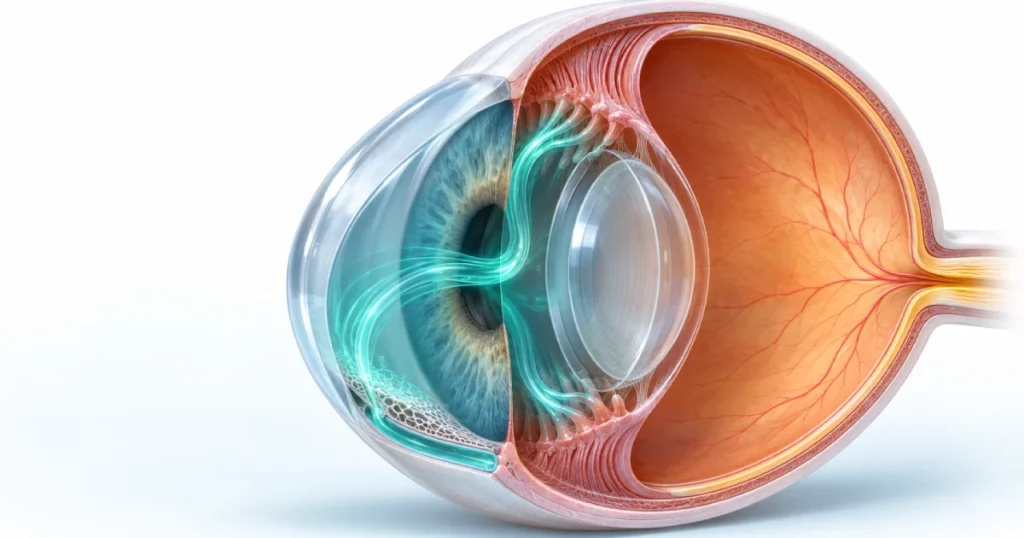
Bimatoprost selectively stimulates prostamide receptors located within the tissues of the eye. This targeted action increases the outflow of aqueous humour (the clear fluid inside the front of the eye) through two drainage routes: the trabecular meshwork and the uveoscleral pathway.
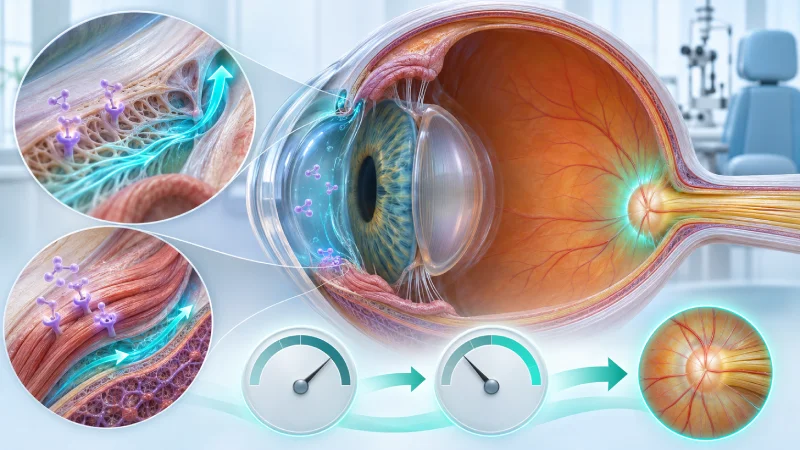
Intraocular pressure (pressure inside the eye) is reduced by bimatoprost. This drop happens because fluid drainage from the eye is improved. Reducing this pressure protects the delicate optic nerve from progressive damage and sight loss.
Local hair follicles interact with bimatoprost when the drops are applied carefully along the upper eyelid margin, which extends the anagen (active growth) phase and increases the number of hairs produced.
After topical eye application, only minimal amounts of bimatoprost enter your general bloodstream. Your liver breaks down absorbed medicine through oxidation, N-deethylation, and glucuronidation.
Your kidneys then clear approximately 67% of these inactive metabolites through your urine. The remaining 25% leaves your body via your faeces. Explore related treatments in our Specialist Care Clinical Insights hub or browse the A–Z Medicine Directory.
Careprost vs Lumigan: Active Ingredient Comparison
Patients frequently ask how Careprost compares to branded eye drops prescribed on the NHS. In the UK, Lumigan is the established MHRA-authorised reference brand containing bimatoprost.
Careprost is an international branded formulation containing the identical active salt molecule. Both medicines deliver the same pharmacological mechanism when prepared at matching concentrations.
| Clinical Parameter | Careprost | Lumigan (UK Reference Brand) |
| Active Ingredient / Salt | (Careprost) Bimatoprost | (Lumigan) Bimatoprost |
| Therapeutic Category | Prostaglandin analogue (prostamide) | Prostaglandin analogue (prostamide) |
| Available Strengths | 0.01% w/v and 0.03% w/v | Secondary / Specialist Use: Eyelash hypotrichosis (off-label UK specialist use) |
| Primary UK Indications | Ocular hypertension, open-angle glaucoma | Ocular hypertension, open-angle glaucoma |
| Secondary / Specialist Use | Eyelash hypotrichosis (sparse lashes) | Eyelash hypotrichosis (specialist use) |
| UK Legal Status | Prescription-Only Medicine (POM) | Prescription-Only Medicine (POM) |
| Controlled Drug Status | Not a UK Controlled Drug | Not a UK Controlled Drug |
Approved Clinical Uses and Dosage Strengths
In the UK, doctors and independent prescribing optometrists authorise bimatoprost following a comprehensive eye examination. Your clinician evaluates your optic nerve health and baseline eye pressure before prescribing.
Primary Licensed Clinical Indications
- Open-Angle Glaucoma: Bimatoprost reduces elevated intraocular pressure to prevent gradual peripheral and central vision loss.
- Ocular Hypertension: Prescribers use bimatoprost when fluid pressure inside the eye is abnormally high, particularly if beta-blocker eye drops are unsuitable.
- Eyelash Hypotrichosis (Off-Label Specialist Use): In the UK, doctors may prescribe bimatoprost 0.03% off-label following an individual assessment to treat clinically sparse eyelashes.
Available Dosage Strengths
Bimatoprost ophthalmic solutions are formulated in specific strengths tailored to clinical tolerance and treatment goals.
- 0.01% Solution (0.1 mg/ml): This lower strength is widely prescribed in the UK for daily glaucoma management. It maintains effective eye pressure control while reducing surface eye redness.
- 0.03% Solution (0.3 mg/ml): This higher standard strength is used when stronger pressure reduction is required or for treating eyelash hypotrichosis. Careprost 0.03% is the standard ophthalmic formulation used for these clinical indications.
- Combination Formulations (Careprost Plus): In international markets, Careprost Plus combines bimatoprost 0.03% with timolol 0.5% for patients requiring dual-action intraocular pressure control under specialist supervision.
Your prescriber will determine the exact strength suited to your clinical needs. Never switch between 0.01% and 0.03% formulations without medical supervision.
How to Apply Careprost Safely
Correct application ensures the active ingredient reaches the intended target while minimising unwanted skin or eye irritation. Before any eye drops are handled, your hands must be washed thoroughly with soap and water. This simple step prevents bacteria from reaching your eye.
For Glaucoma and Eye Pressure Control
- Tilt your head back gently and pull down your lower eyelid to form a small pocket.
- Hold the dropper tip close to your eye without letting it touch your eye, eyelashes, or skin.
- Usually administered once daily in the evening, squeeze one drop into the lower eyelid pocket, then gently close your eye and press one finger against the inner corner near your nose for one minute. This prevents the medicine from draining into your tear duct and bloodstream.
For Eyelash Hypotrichosis (Using Careprost Eye Drops for Eyelashes)
- Ensure your face is clean and remove all eye make-up and contact lenses before bedtime.
- A sterile, single-use applicator brush should be used to hold one drop of bimatoprost 0.03%. Using a fresh brush each time keeps the application hygienic.
- Lightly draw the applicator along the upper eyelid margin where your eyelashes meet the skin.
- Do not apply the solution to your lower eyelid, as this increases unwanted hair growth on your cheeks.
- Blot away any excess liquid outside the upper eyelid margin immediately using a clean tissue.
If you are unsure how to instil eye drops safely, ask your dispensing pharmacist to demonstrate the technique.
Careprost Eye Drops Side Effects, Interactions, and Safety Precautions
Like all active medicines, bimatoprost can cause unwanted effects alongside its clinical benefits. Most side effects of bimatoprost eye drops (including Careprost) are mild and affect only the surface of the eye.
| Category | Side Effect / Symptom | Clinical Details & Action Needed |
| Frequent Side Effects (Seen in up to 1 in 10 users) | Conjunctival hyperaemia | Mild redness of the white of the eye can occur; this surface redness is typically mild and temporary. |
| Frequent Side Effects (Seen in up to 1 in 10 users) | Eye surface discomfort | Itchy, dry, or watery eyes immediately after application. |
| Frequent Side Effects (Seen in up to 1 in 10 users) | Eyelid skin darkening | Darkening of the skin on the eyelids where the drops touch. |
| Frequent Side Effects (Seen in up to 1 in 10 users) | Eyelash changes | Gradual thickening and darkening of your eyelashes. |
| Serious Side Effects (Requiring Urgent Medical Review) | Permanent Iris Colour Change | Bimatoprost increases brown melanin pigment in the iris; if you have blue, green, hazel, or grey eyes, your eye colour may turn permanently browner over months of use. |
| Serious Side Effects (Requiring Urgent Medical Review) | Vision Changes | Sudden blurred eyesight, double vision, or halos around lights require prompt medical review. |
| Serious Side Effects (Requiring Urgent Medical Review) | Serious Eye Irritation | Sensitivity to light, sticky discharge, swelling, or persistent eye pain may develop; prompt clinical evaluation is required if these symptoms appear. |
| Serious Side Effects (Requiring Urgent Medical Review) | Allergic Reactions | Swelling around your face, lips, or eyelids, or difficulty breathing requires urgent medical attention. |
Contact your GP if you notice any side effects, or speak with your pharmacist for advice. You can also report suspected side effects directly to the MHRA via the Yellow Card Scheme at yellowcard.mhra.gov.uk or through the Yellow Card app.
Drug Interactions and Contact Lenses
- Other Glaucoma Drops: Using two prostaglandin analogues together (such as latanoprost or travoprost alongside bimatoprost) can paradoxically raise eye pressure.
- Leaving a Gap Between Drops: To prevent the second drop from washing out the first, at least five minutes must be left between applications when multiple eye medicines are used.
- Contact Lenses: Many multidose bimatoprost bottles contain benzalkonium chloride, a preservative that discolours soft contact lenses. Before drops are applied, contact lenses must be removed. Waiting at least 15 minutes before reinserting them prevents the preservative from discolouring soft lenses.
Pregnancy, Breastfeeding, Alcohol, and Driving
 Pregnancy
Do not use bimatoprost during pregnancy unless your specialist confirms the clinical benefit outweighs potential risks to the unborn baby.
 Breastfeeding
Avoid bimatoprost while breastfeeding, as animal studies indicate small amounts of the active substance pass into breast milk.
 Alcohol
 does not interact directly with topical bimatoprost, though heavy drinking negatively impacts overall eye health.
 Driving
Eye drops can cause brief blurred vision or watering right after application. Wait until your vision clears completely before driving or operating machinery.
Storage and Handling
Store your bottle upright below 25°C and keep it out of sight and reach of children. To protect your eyes from bacterial infections, any opened multidose bottle must be discarded after 28 days.
Accessing Bimatoprost Treatment Responsibly in the UK
In the UK, bimatoprost is strictly classified as a Prescription-Only Medicine (POM) under MHRA regulations. You cannot legally access Careprost or Lumigan over the counter without clinical authorisation.
To access treatment safely, book an appointment with your GP, ophthalmologist, or an independent prescribing optometrist. A qualified clinician will check your eye pressure, inspect your optic nerve, and review your medical history.
Once a valid NHS or private prescription is issued, a GPhC-registered pharmacy will dispense a UK-licensed bimatoprost formulation (such as Lumigan or generic bimatoprost 0.01%/0.03%). Careprost is an international brand not routinely licensed for general UK retail supply. Never source unverified ophthalmic drops or eyelash serums from unregulated websites, as contaminated or counterfeit bottles risk severe corneal infection and permanent sight loss.
Frequently Asked Questions About Careprost
Q: Is Careprost safe for eyelash growth?
A: Using Careprost eyelash growth is generally safe when prescribed off-label under medical supervision. Because it contains active bimatoprost, you must apply it solely along the upper eyelid margin. Always consult a qualified UK doctor or prescriber first to confirm suitability and avoid unnecessary eye irritation or pigmentation risks.
Q: Is Careprost the same as Latisse?
A: Yes, Careprost and Latisse contain the exact same active ingredient, bimatoprost 0.03%. Both formulations work the same way to stimulate longer, thicker eyelashes. However, Latisse is a branded product licensed in the US specifically for eyelash hypotrichosis, whereas Careprost is an international branded generic ophthalmic solution manufactured by Sun Pharmaceutical Industries.
Q: Is Careprost the same as bimatoprost?
A: Careprost is a brand name, while bimatoprost is the active pharmaceutical ingredient inside it. Every bottle of Careprost 0.03% contains bimatoprost as its active medicine. Therefore, Careprost delivers the same clinical effects as other UK-authorised medicines containing bimatoprost at the identical strength.
Q: What are the side effects of using Careprost eye drops?
A: Temporary darkening of the eyelid skin, dry eyes, itching, and mild eye redness are among the common side effects reported. Less commonly, bimatoprost can cause permanent brown darkening of light-coloured irises. Should sudden vision changes, discharge, swelling, or severe eye pain occur, prompt medical advice must be sought.
Q: How long does it take to see Careprost results?
A: For ocular hypertension and glaucoma, eye pressure begins dropping within four hours of your first dose. For eyelash hypotrichosis, noticeable Careprost results in lash length and thickness typically appear after eight weeks of nightly application, reaching full effect at sixteen weeks.
Official Clinical References
- British National Formulary (BNF): Bimatoprost — Indications, Dosing, Side Effects, and Prescribing Guidance
- National Institute for Health and Care Excellence (NICE): Glaucoma: Diagnosis and Management — NICE Guideline NG81
- NHS Health A-Z: Glaucoma Overview and Eye Drop Treatments
- Medicines and Healthcare products Regulatory Agency (MHRA): Yellow Card Scheme for Reporting Suspected Side Effects
Medical Disclaimer
This article is for informational purposes only and does not replace professional medical advice. Always consult a registered healthcare professional before starting or changing any treatment.