
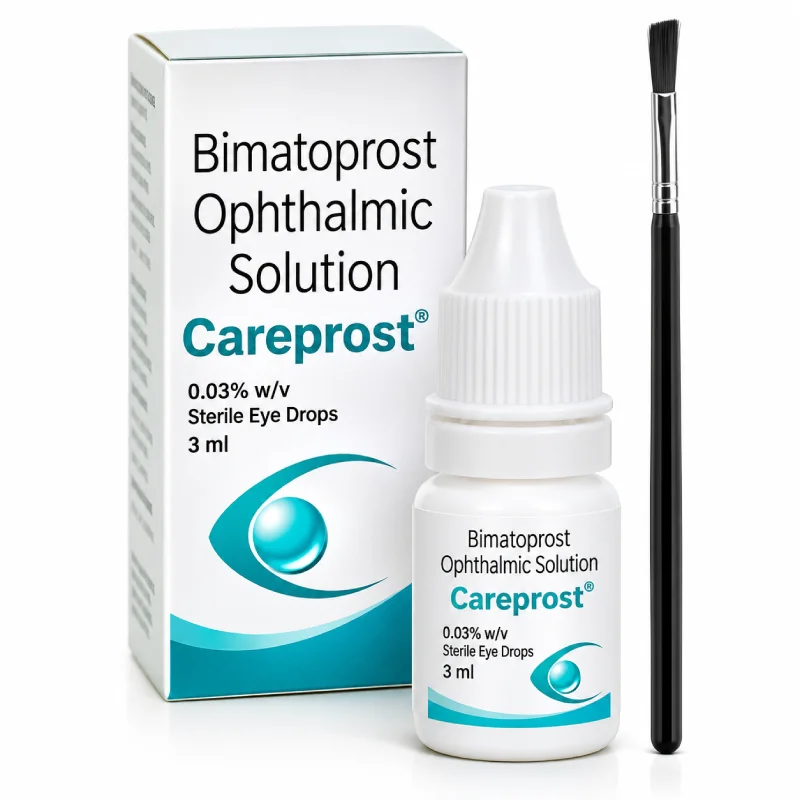
Careprost 0.03%: Bimatoprost Eye and Lash Guide UK
Careprost 0.03% is an ophthalmic solution manufactured by Sun Pharmaceutical Industries Limited. It contains 0.03% bimatoprost. In the UK, bimatoprost is a Prescription-Only Medicine (POM) requiring clinical assessment by an authorised prescriber.
What is Careprost 0.03% (Bimatoprost 0.03%)?
Is Careprost 0.03% the same as Lumigan 0.03%?
Yes. Careprost 0.03% contains bimatoprost 0.03%, the same active ingredient (prostaglandin analogue) found in the UK reference brand Lumigan 0.03%. Both formulations selectively mimic prostaglandin receptors to increase fluid outflow and stimulate eyelash follicle growth under regulated GP consultation.
Comparing Careprost 0.03% and Lumigan 0.03%
| Feature | Careprost 0.03% | Lumigan 0.03% |
| Active Ingredient | Bimatoprost | Bimatoprost |
| Strength | 0.03% w/v | 0.03% w/v |
| Mechanism of Action | Selective prostamide receptor agonist | Selective prostamide receptor agonist |
| Chemical Class | Synthetic prostamide analogue | Synthetic prostamide analogue |
| Bioequivalence | Identical active bimatoprost molecule | UK MHRA-authorised reference medicine |
| UK Legal Status | Prescription-Only Medicine (POM) | Prescription-Only Medicine (POM) |
Bimatoprost Mechanism of Action and Clinical Guidance
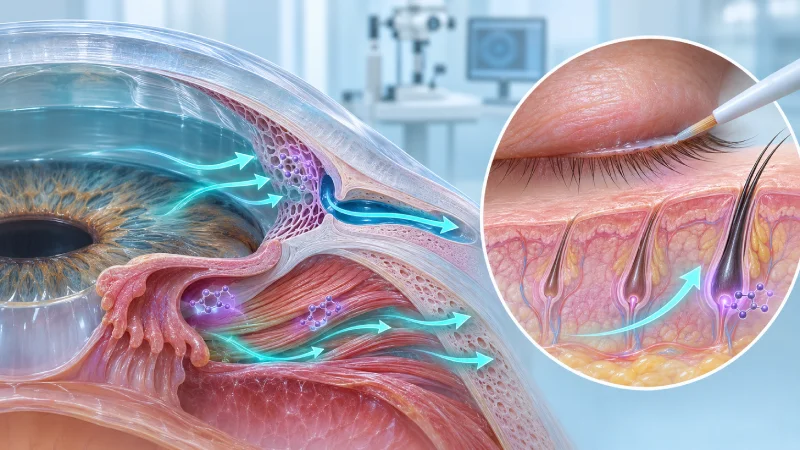
Bimatoprost acts as a synthetic prostamide F2-alpha analogue. It lowers eye pressure by increasing aqueous humour drainage through the trabecular meshwork and uveoscleral pathways. When applied along the upper eyelid margin, bimatoprost prolongs the anagen (growth) phase of eyelash follicles.
Your body absorbs small amounts of bimatoprost into the bloodstream. Liver enzymes metabolise the medicine via oxidation, N-deethylation, and glucuronidation. Your kidneys excrete roughly 67% of the metabolites in urine, while 25% leaves via faeces. Under UK law, bimatoprost is regulated as a Prescription-Only Medicine (POM).
Approved Clinical Indications for Bimatoprost 0.03%
UK prescribers authorise bimatoprost following a formal eye or specialist clinical examination. Approved clinical indications include:
- Open-Angle Glaucoma: Reduces elevated intraocular pressure to protect the optic nerve from damage.
- Ocular Hypertension: Lowers high fluid pressure inside the eye when beta-blockers are unsuitable.
- Eyelash Hypotrichosis: Manages inadequate or sparse eyelashes when prescribed following specialist clinical assessment (in the UK, bimatoprost 0.03% is licensed for glaucoma and prescribed off-label by specialist clinicians for eyelash hypotrichosis).
Bimatoprost 0.03% Safety Advice and GP Guidance
Understanding bimatoprost side effects helps you protect your eyes safely alongside your doctor.
| Common Side Effects | Serious Side Effects |
| • Mild eye redness (conjunctival hyperaemia) | • Sudden changes in vision or blurred eyesight |
| • Itchy, dry, or watery eyes | • Severe eye pain, swelling, or discharge |
| • Darkening of the eyelid skin | • Eyelid inflammation (blepharitis) or corneal irritation |
| • Gradual darkening of iris eye colour | • Allergic facial swelling or breathing trouble |
Report any suspected side effects directly to the MHRA via the Yellow Card Scheme at yellowcard.mhra.gov.uk.
Available Strengths and Formulations
Your doctor selects the right bimatoprost strength based on your eye pressure response and tolerance.
- 0.01% Solution: A lower UK-licensed strength designed to maintain pressure control while reducing surface eye redness.
- 0.03% Solution: The standard therapeutic strength used for glaucoma management and Careprost eyelash serum applications.
- Careprost Plus (Bimatoprost 0.03% and Timolol Maleate 0.5%): A combination formulation pairing bimatoprost 0.03% with timolol 0.5% for patients needing dual-action pressure control.
Lower strengths help minimise local eye irritation. Higher 0.03% formulations deliver maximum follicle stimulation and fluid drainage when prescribed.
Bimatoprost Key Safety Precautions and Lifestyle Advice
 Liver
Mild liver impairment rarely alters topical absorption, though severe disease requires GP review.
 Kidney
s clear most inactive metabolites. Discuss severe renal impairment with your prescriber.
 Alcohol
 does not interact directly with bimatoprost eye drops, though excessive drinking affects general eye health.
 Driving
Bimatoprost may cause brief blurred vision after application. Wait until your sight clears before driving.
 Pregnancy
Avoid bimatoprost during pregnancy unless your specialist confirms the clinical benefit outweighs foetal risks.
 Breastfeeding
Do not use bimatoprost while breastfeeding, as animal studies show active medicine passes into breast milk.
Always consult a qualified UK healthcare professional before starting, changing, or switching your medicine. If you hold a valid UK prescription for Bimatoprost, discuss with your prescriber whether generic Bimatoprost 0.03% or an equivalent bioequivalent brand is suitable for your clinical needs.
Bimatoprost Medicine Interactions
Topical bimatoprost reaches very low blood levels, so systemic interactions remain rare. Tell your GP about all eye drops you use.
- Other Prostaglandin Analogues (Latanoprost, Travoprost): Combining two prostaglandin drops can paradoxically raise eye pressure.
- Contact Lenses: Benzalkonium chloride preservatives in drops can discolour soft contact lenses. Remove lenses before applying and wait 15 minutes.
- Other Eye Drops: Space different ophthalmic drops at least five minutes apart to prevent washing out the active salt.
Accessing Bimatoprost Treatment Responsibly in the UK
In the UK, you must access bimatoprost treatment responsibly using a valid NHS or private prescription. Qualified UK doctors or independent prescribing optometrists assess your eye health before issuing a prescription.
GPhC-registered pharmacies dispense licensed bimatoprost 0.01% and 0.03% solutions following clinical checks. Never source unverified serums from unregulated websites without medical oversight.
Bimatoprost 0.03% Frequently Asked Questions
Q: What is Bimatoprost 0.03% used for?
A: Bimatoprost 0.03% is clinically prescribed for two primary purposes. First, it is used in ophthalmology to reduce elevated fluid pressure inside the eye (intraocular pressure) for patients managing open-angle glaucoma or ocular hypertension. Second, it is prescribed to treat eyelash hypotrichosis (inadequate or sparse eyelashes) by stimulating the hair follicles to grow longer, thicker, and darker eyelashes.
Q: Can I use CMC eye drop daily?
A: Yes, you can safely use CMC (carboxymethylcellulose or carmellose) eye drops on a daily basis. They act as artificial tears to relieve dry, irritated, or tired eyes. If you are using a standard bottle that contains preservatives, it is generally recommended to limit use to four to six times a day to avoid eye irritation. If you need to apply them more frequently, or if you wear contact lenses, choose preservative-free CMC eye drops, which can be used as often as needed.
Q. Is iris colour change from bimatoprost permanent?
A: Yes, gradual darkening of the iris (increased brown pigmentation) can be permanent, even after stopping treatment, whereas darkening of the eyelid skin is usually reversible.
Q: How long does Careprost eyelash growth serum take to show results?
A: Clinical studies show visible improvements in eyelash length and thickness typically appear after 8 weeks of nightly application. Maximum results usually develop around week 16 under proper medical guidance.
Q: How do you apply Careprost eyelash serum safely?
A: Apply one drop to a sterile applicator and draw it along the upper eyelid margin once nightly. Blot away excess solution immediately to prevent unwanted hair growth on your cheeks.
Summary and Clinical Overview
Careprost 0.03% provides 0.03% active bimatoprost and shares the same pharmacological profile as UK-licensed Lumigan 0.03%. Because prostaglandin analogues carry risks of iris pigmentation and eye irritation, UK rules require a valid prescription. Always consult your GP or eye specialist to confirm safe use and the right strength.
References and Official Data Sources
- NICE Clinical Guidelines – Glaucoma: Diagnosis and Management (NG81)
- British National Formulary (BNF) – Bimatoprost Monograph
- NHS Health A-Z – Glaucoma Treatment Overview
Medical Disclaimer
This guide is an educational clinical reference monograph provided for informational purposes only. It does not replace independent clinical judgement or direct consultation with a qualified UK healthcare professional. This directory does not sell, supply, or dispense medicines; Prescription-Only Medicines (POMs) are supplied strictly by GPhC-registered pharmacies against a valid NHS or private prescription.


Reviews
There are no reviews yet.