

Within the modafinil drug class (wakefulness-promoting agents), modafinil is a centrally acting medicine authorised by the MHRA in the UK for narcolepsy (a chronic neurological sleep disorder). It operates primarily by selectively inhibiting dopamine transporter proteins (brain proteins that reabsorb chemical messengers), offering sustained daytime alertness without intense amphetamine-like stimulation.
Core Chemical and Pharmacological Profile
Understanding the modafinil drug class helps you see how this medicine differs from classic stimulants. UK clinical formularies group modafinil under wakefulness-promoting agents and centrally acting sympathomimetics, with Modvigil serving as an international branded generic tablet delivering this active salt.
| Parameter | Clinical Specification |
| Active Substance / Salt | Modafinil (racemic mixture of R- and S-enantiomers) |
| IUPAC / Chemical Class | Benzhydrylsulfinylacetamide derivative |
| Pharmacological Category | Wakefulness-promoting agent (modafinil drug class / centrally acting sympathomimetic) |
| ATC Code | N06BA07 |
| Bioavailability | Rapid oral absorption; absolute bioavailability undetermined (food delays absorption by ~1 hour) |
| Plasma Protein Binding | Approximately 60% (primarily bound to serum albumin) |
| Elimination Half-Life (t½) | Approximately 12 to 15 hours |
| Primary Clearance Route | Hepatic metabolism (hydrolytic deamidation and CYP3A4); ~80% excreted in urine |
| UK Regulatory Status | Prescription-Only Medicine (POM) — Not a UK Controlled Drug |
How Modafinil Works in the Body
If you wonder what class drug is modafinil, it belongs to wakefulness-promoting agents. Medicines in the modafinil drug class act selectively on specific brain regions that regulate your sleep-wake cycle. Unlike traditional amphetamines, modafinil does not trigger widespread adrenaline release across your nervous system.
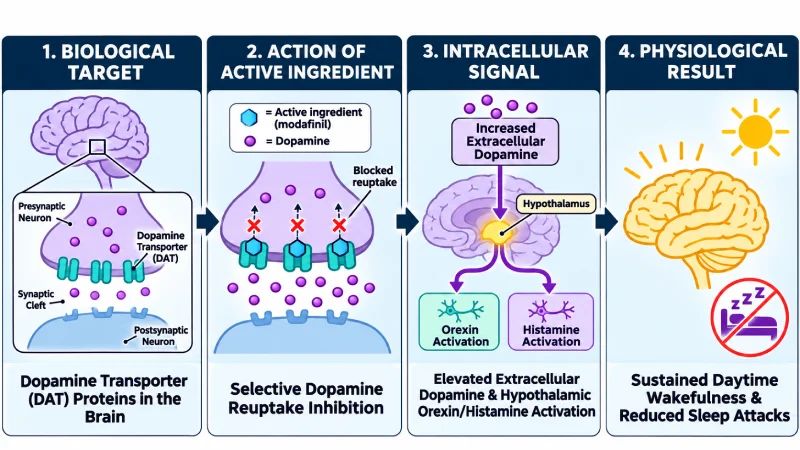
Instead, modafinil binds selectively to dopamine transporter proteins (reuptake channels) in your brain. This binding blocks dopamine reabsorption, gently raising extracellular dopamine (a key alertness neurotransmitter) levels in wake-promoting areas.
Increased dopamine signalling stimulates downstream histamine, orexin, and noradrenaline pathways (neurochemical alert systems) in your hypothalamus. These coordinated signals sustain daytime wakefulness while avoiding sharp energy crashes.
How Long Modafinil Stays in the Body
Understanding how your body processes modafinil helps explain why morning timing prevents night-time sleep disruption.
- Absorption: Your digestive tract absorbs modafinil steadily, reaching peak concentration (Cmax) at a peak time (Tmax) of 2 to 4 hours. Taking tablets with food does not reduce overall absorption, though a heavy meal delays Tmax by roughly one hour.
- Distribution: Modafinil distributes well throughout body water with an apparent volume of distribution (Vd) of approximately 0.9 L/kg. Roughly 60% of the active substance binds to plasma proteins (blood transport proteins) in circulation.
- Metabolism: Your liver metabolises modafinil extensively via hydrolytic deamidation (chemical breakdown) and the CYP3A4 liver enzyme system. It forms two major inactive metabolites: modafinil acid and modafinil sulfone.
- Excretion: Your kidneys eliminate roughly 80% of the administered dose as inactive metabolites in your urine. Less than 10% leaves your body unchanged, with an elimination half-life (t½) of 12 to 15 hours.
Approved UK Medical Uses and Dosing
In the UK, the MHRA restricts routine modafinil licensing strictly to narcolepsy after reviewing cardiovascular and skin safety data. UK prescribers follow NICE and BNF guidelines when initiating treatment.
- Approved Indication: Authorised to treat excessive daytime sleepiness in adults diagnosed with narcolepsy, with or without cataplexy (sudden muscle weakness).
- Available Tablet Strengths: Standard UK formulations include 100 mg and 200 mg oral tablets, while Modvigil is formulated as a 200 mg strength tablet.
- Standard Adult Dose: Prescribers typically advise 200 mg taken once daily in the morning, up to a maximum of 400 mg daily.
- Organ Clearance Adjustments: Your doctor will halve your daily dose to 100 mg if you have severe hepatic impairment (serious liver disease). Clinicians also exercise caution and evaluate dosing carefully if you have severe renal impairment (reduced kidney function).
Safety Warnings, Contraindications, and Interactions
Rigorous safety screening protects you from serious cardiovascular, dermatological, and drug-interaction risks during therapy with the modafinil drug class.
Absolute Contraindications
You must never take modafinil or Modvigil if you have any of the following conditions:
- Hypersensitivity: A known allergy to modafinil or any tablet excipients (inactive binding ingredients).
- Uncontrolled Hypertension: Moderate to severe high blood pressure that is not safely controlled with medicine.
- Cardiac Arrhythmias: Known irregular heart rhythms or significant structural heart disease.
- Pregnancy and Breastfeeding: Pregnancy or active breastfeeding, as UK safety data warns of potential foetal malformations (birth defects).
Drug-Drug Interactions
Modafinil alters liver enzyme activity, which changes how your body clears several essential medicines.
- Major Interactions: Modafinil induces CYP3A4 liver enzymes, significantly reducing the effectiveness of hormonal contraceptives (birth control pills, patches, and implants). You must use reliable barrier contraception during treatment and for two full months after stopping modafinil.
- Moderate Interactions: Modafinil inhibits CYP2C19 liver enzymes, which can raise blood levels of warfarin (a blood thinner), diazepam, phenytoin, and tricyclic antidepressants. Concurrent use with ciclosporin (an immunosuppressant) also reduces ciclosporin blood levels dangerously.
- Minor Interactions: Standard caffeine intake may occasionally amplify mild jitteriness or palpitations, though it does not alter modafinil clearance.
Accessing Treatment Safely in the UK
In the UK, modafinil is strictly regulated as a Prescription-Only Medicine (POM)—not a Pharmacy (P) over-the-counter medicine—and requires a valid NHS or private prescription from an authorised UK prescriber, with dispensing by a GPhC-registered pharmacy.
Never source unverified wakefulness tablets from unregulated websites without a formal specialist diagnosis and medical supervision.
 MHRA Patient Information and Yellow Card
Possible Side Effects of Modafinil
Like all active medicines, modafinil can cause unwanted effects alongside its intended wakefulness benefits. Report any new symptoms to your doctor promptly.
| Frequency Category | Approximate Incidence | Associated Side Effects & Clinical Events |
| Very Common | $\ge 1/10$ | Headache (affecting more than 1 in 10 patients). |
| Common | $\ge 1/100$ to $< 1/10$ | Dizziness, insomnia (difficulty sleeping), nausea, dry mouth, diarrhoea, nervousness, and palpitations (noticeable heartbeat). |
| Uncommon | $\ge 1/1,000$ to $< 1/100$ | Blurred vision, hypertension (raised blood pressure), tachycardia (fast heart rate), muscle weakness, paresthesia (pins and needles), and mood swings. |
| Rare / Serious | $< 1/1,000$ | Stevens-Johnson syndrome (a life-threatening blistering skin rash), toxic epidermal necrolysis (severe skin peeling), angioedema (facial or throat swelling), psychosis, and suicidal ideation. |
Stop taking modafinil immediately and seek emergency hospital care if you develop any skin rash, blistering, mouth ulcers, or chest pain.
Adverse Reaction Reporting: Healthcare professionals and patients should report suspected adverse drug reactions (ADRs) directly to the MHRA via the Yellow Card Scheme at yellowcard.mhra.gov.uk or via the MHRA Yellow Card app.
Frequently Asked Questions
Q: What class of drug is modafinil, and how quickly does it start working?
A: Within the modafinil drug class (wakefulness-promoting agents), modafinil enters your bloodstream steadily and reaches peak levels within 2 to 4 hours. You will typically notice improved daytime alertness within two hours of swallowing your morning tablet. Taking your tablet after a heavy meal may delay this onset by approximately one hour.
Q: What is the maximum recommended daily frequency for Modafinil?
A: Most adults take modafinil once daily in the morning immediately after waking. In specific clinical cases, your specialist may split your daily dose into morning and midday administrations. Never take modafinil in the late afternoon or evening, as its 15-hour duration causes severe insomnia (sleeplessness).
Q: Can you consume alcohol while taking Modafinil or Modvigil?
A: You should avoid drinking alcohol while taking modafinil or Modvigil. Combining alcohol with central nervous system stimulants (brain-active medicines) impairs your judgement and coordination unpredictably. Alcohol also worsens daytime drowsiness and counteracts your prescribed narcolepsy therapy.
Q: How do patients access Modvigil (Modafinil) in the UK?
A: In the UK, modafinil is strictly regulated as a Prescription-Only Medicine (POM) requiring specialist clinical assessment. Patients access treatment responsibly only with a valid prescription issued by a GMC-registered clinician. A GPhC-registered pharmacy must then dispense your tablets following mandatory safety checks.
Clinical References and Citations
- British National Formulary (BNF) Monograph: Modafinil — Indications, Dosing, Contraindications, and Interactions (bnf.nice.org.uk/drugs/modafinil/).
- National Institute for Health and Care Excellence (NICE) Guidelines: Evidence Summary and Clinical Guidance on Narcolepsy and Excessive Daytime Sleepiness (nice.org.uk).
- NCBI / PubMed Literature: Robertson P Jr, Hellriegel ET. Clinical pharmacokinetic profile of modafinil. Clin Pharmacokinet. 2003;42(2):123-37 (PMID: 12537513).
Medical Disclaimer
This guide is an educational reference monograph provided for informational purposes only. It does not replace independent clinical judgement or direct consultation with a qualified UK healthcare professional. This directory does not sell or dispense medicines; Prescription-Only Medicines (POMs) are supplied strictly by GPhC-registered pharmacies against a valid NHS or private prescription.