

Executive Clinical Overview
Zopiclone is a non-benzodiazepine hypnotic (a short-acting sleep medicine) authorised by the MHRA in the UK for the short-term treatment of severe insomnia (persistent difficulty falling or staying asleep), as detailed in official Zopiclone BNF clinical guidelines. It operates primarily by enhancing gamma-aminobutyric acid (GABA, a natural calming brain chemical) activity, offering faster sleep onset and fewer night-time awakenings.
Core Chemical and Pharmacological Profile
| Parameter | Clinical Specification |
| Active Substance / Salt | Zopiclone |
| IUPAC / Chemical Class | Cyclopyrrolone derivative |
| Pharmacological Category | Non-benzodiazepine hypnotic (“Z-drug”) |
| ATC Code | N05CF01 |
| Bioavailability | Approximately 75% to 80% |
| Plasma Protein Binding | Approximately 45% (weakly bound) |
| Elimination Half-Life (t½) | Approximately 5 hours (increases to 7 hours in older adults) |
| Primary Clearance Route | Hepatic metabolism (CYP3A4 and CYP2C8); excreted via urine (~80%) and faeces (~16%) |
| UK Regulatory Status | Prescription-Only Medicine (POM) / Class C, Schedule 4 (Part 1) Controlled Drug |
How Zopiclone Works in the Body
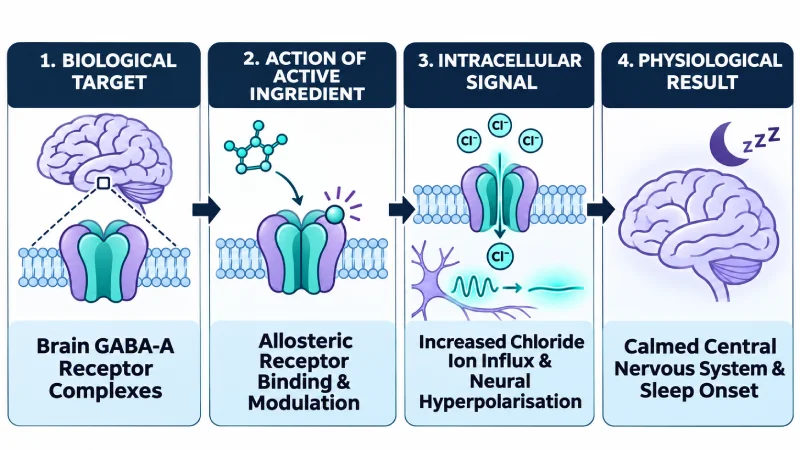
Zopiclone calms overactive nerve signalling in your central nervous system. Although structurally distinct from benzodiazepines, it binds to the same receptor complex in your brain.
Specifically, zopiclone attaches to gamma-aminobutyric acid type A (GABA-A) receptors (proteins on nerve cells that regulate brain excitability). This binding increases the frequency with which chloride ion channels open (tiny pores that let negatively charged ions enter cells).
The influx of chloride ions slows down electrical nerve transmission. You experience reduced restlessness, muscle relaxation, and faster sleep induction.
How Long Zopiclone Stays in the Body
Understanding how your body processes zopiclone helps you avoid next-day drowsiness.
- Absorption: Your digestive tract absorbs zopiclone rapidly after you swallow it. Peak blood concentration (Cmax) arrives within 1.5 to 2 hours (Tmax). Heavy meals slightly delay absorption but do not reduce overall bioavailability.
- Distribution: Zopiclone distributes quickly across body tissues, showing a volume of distribution (Vd) of roughly 100 litres. Only 45% binds to plasma proteins.
- Metabolism: Your liver breaks down zopiclone using CYP3A4 and CYP2C8 enzymes (liver proteins that process medicines). This creates an active N-oxide metabolite and an inactive N-desmethyl metabolite.
- Excretion: Your kidneys eliminate about 80% of these metabolites in urine, while 16% exits in faeces. The elimination half-life (t½) is roughly 5 hours in healthy adults.
Approved UK Indications and Zopiclone BNF Dosage Rules
Under Zopiclone BNF and NICE guidelines, prescribers reserve zopiclone for severe, disabling insomnia. Treatment must remain strictly short-term, lasting from a few days up to four weeks maximum.
- Standard Adult Dose (7.5 mg): Healthy adults usually take 7.5 mg once nightly immediately before bed. The maximum dose of zopiclone in routine UK clinical practice is 7.5 mg daily.
- Reduced Starting Dose (3.75 mg): Prescribers initiate Zopiclone 3.75 mg tablets for adults aged 65 and over. This lower strength reduces next-day falls and confusion.
- Renal and Hepatic Adjustments: Patients with liver impairment, kidney dysfunction, or chronic respiratory insufficiency also start at 3.75 mg. You swallow film-coated tablets whole with a glass of water.
Contraindications, Overdose Risks, and Drug Interactions
Strict safety boundaries protect you from severe respiratory and neurological complications.
Absolute Contraindications
- Myasthenia Gravis: Do not take zopiclone if you have myasthenia gravis (a condition causing severe muscle weakness).
- Severe Sleep Apnoea: Avoid zopiclone if you experience sleep apnoea syndrome (repeated breathing pauses during sleep).
- Respiratory Failure: Prescribers do not give zopiclone to patients with severe breathing difficulties.
- Severe Liver Impairment: Advanced hepatic insufficiency prevents safe drug clearance and risks brain toxicity.
- Pregnancy and Breastfeeding: Avoid zopiclone during pregnancy or breastfeeding to protect your baby from sedation or withdrawal.
Drug-Drug Interactions
- Major Interactions: Combining zopiclone with alcohol or opioid painkillers causes life-threatening central nervous system depression and slowed breathing. Benzodiazepines and sedating antipsychotics create similar dangerous additive sedation.
- Moderate Interactions: Potent CYP3A4 inhibitors (such as erythromycin, clarithromycin, ketoconazole, and ritonavir) slow liver clearance and heighten drowsiness.
- Minor Interactions: CYP3A4 inducers (such as rifampicin, carbamazepine, and St John’s Wort) speed up elimination and weaken sleep benefits.
Recognising an Overdose of Zopiclone
An overdose of zopiclone causes extreme drowsiness, confusion, slurred speech, floppy muscles, low blood pressure, and shallow breathing. Seek immediate emergency hospital attention via 999 if someone takes too many tablets.
Accessing Treatment Safely in the UK
In the UK, Zimovane (zopiclone) is regulated under MHRA guidelines as a Class C, Schedule 4 Controlled Drug. Prescription-Only Medicines (POM) require a valid NHS or private prescription issued by a qualified UK prescriber and dispensed by a GPhC-registered pharmacy. Pharmacy (P) medicines may be supplied over the counter following a clinical screening questionnaire under the supervision of a GPhC-registered pharmacist, though zopiclone always requires a prescription.
Never source unregulated sleep tablets from unverified websites. Always discuss persistent sleep troubles with your GP before starting hypnotic therapy.
 View Official MHRA Patient Leaflet
Possible Side Effects and Long-Term Use Risks
Most patients experience mild side effects during short courses, while prolonged use introduces serious dependence risks.
| Frequency Category | Approximate Incidence | Associated Side Effects & Clinical Events |
| Common | $\ge 1/100$ to $< 1/10$ | Bitter or metallic taste in the mouth (dysgeusia), dry mouth, and next-day drowsiness. |
| Uncommon | $\ge 1/1,000$ to $< 1/100$ | Nausea, vomiting, dizziness, headache, nightmares, and mild agitation. |
| Rare / Serious | $< 1/1,000$ | Anterograde amnesia (memory gaps after taking the tablet), hallucinations, falls in elderly patients, severe allergic swelling (angioedema), and complex sleep behaviours like sleep-walking. |
Managing Long-Term Zopiclone Use and Dependence
Long-term zopiclone use beyond four weeks leads to tolerance (needing higher doses for the same effect) and physical dependence. Stopping suddenly triggers rebound insomnia, severe anxiety, tremors, and sweating.
If you feel reliant on sleeping tablets, speak openly with your GP about help for zopiclone addiction. Your doctor can design a gradual tapering schedule or refer you to local zopiclone addiction treatment support services.
Adverse Reaction Reporting: Healthcare professionals and patients should report suspected adverse drug reactions (ADRs) directly to the MHRA via the Yellow Card Scheme at yellowcard.mhra.gov.uk or via the MHRA Yellow Card app.
Frequently Asked Questions (FAQs)
Q: What is zopiclone used for?
A: Zopiclone is a prescription-only non-benzodiazepine hypnotic medicine authorised in the UK for the short-term management of severe, disabling insomnia. It helps you fall asleep faster and reduces night-time awakenings. Due to dependence risks, UK clinical guidelines strictly limit treatment duration to a maximum of four weeks under medical supervision.
Q: Is zopiclone the same as diazepam?
A: No, zopiclone and diazepam are different medicines. Zopiclone is a cyclopyrrolone “Z-drug” prescribed specifically as a short-term sleeping aid for severe insomnia. Diazepam is a benzodiazepine used primarily for anxiety, muscle spasms, and seizure disorders. While both enhance GABA activity in the brain, they have distinct chemical structures, licensed indications, and side-effect profiles.
Q: Is zopiclone a strong sleeping pill?
A: Yes, zopiclone is a potent non-benzodiazepine hypnotic prescribed for short-term management of severe insomnia. It acts rapidly on central nervous system receptors to induce sleep. Because of its strength and dependence risks, UK clinical guidelines restrict use to a maximum of four weeks under strict medical supervision.
Q: Why do doctors not prescribe zopiclone?
A: Doctors do prescribe zopiclone, but only cautiously and for short periods. They avoid long-term prescriptions because zopiclone carries significant risks of tolerance, physical dependence, and addiction. Prolonged use can also cause next-day drowsiness, impaired coordination, and severe withdrawal symptoms if stopped suddenly, making short-term review essential for patient safety.
Clinical References and Citations
- British National Formulary (BNF) Monograph: Zopiclone – Indications, Dose, Contraindications, and Controlled Drug Status (bnf.nice.org.uk).
- MHRA Summary of Product Characteristics (SmPC via eMC): Zopiclone 3.75 mg and 7.5 mg Film-Coated Tablets (medicines.org.uk).
- National Institute for Health and Care Excellence (NICE) Guidelines: Clinical Knowledge Summaries (CKS) – Insomnia Management (cks.nice.org.uk).
- NCBI / PubMed Literature: Clinical Pharmacology and Therapeutic Efficacy of Zopiclone in Insomnia (PMID: 2891490).
Medical Disclaimer
This guide is an educational reference monograph provided for informational purposes only. It does not replace independent clinical judgement or direct consultation with a qualified UK healthcare professional. This guide does not sell or dispense medicines; Prescription-Only Medicines (POMs) are supplied strictly by GPhC-registered pharmacies against a valid NHS or private prescription.