Executive Clinical Overview
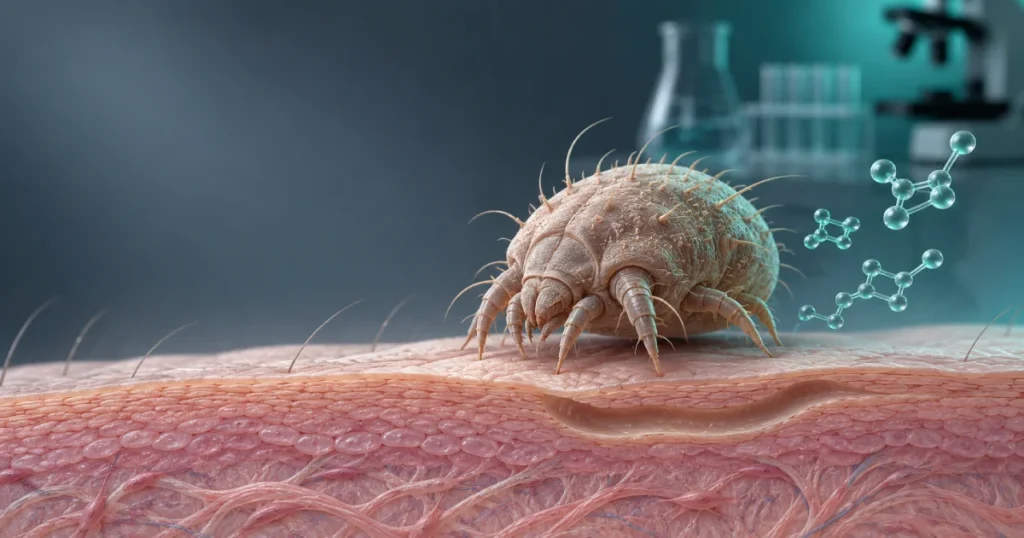
Ivermectin (3 mg oral tablets) is an MHRA-licensed antiparasitic medicine used to treat human sarcoptic scabies. This contagious skin infestation is caused by Sarcoptes scabiei mites. Following the correct ivermectin dosage for scabies ensures safe and effective treatment. The medicine works by selectively binding to parasite nerve and muscle channels, paralysing adult mites without harming human nerve cells.
Core Chemical and Pharmacological Profile
| Parameter | Clinical Specification |
| Active Substance / Salt | Ivermectin (mixture of ≥90% 22,23-dihydroavermectin B1a and <10% B1b) |
| IUPAC / Chemical Class | Macrocyclic lactone (Avermectin derivative) |
| Pharmacological Category | Ectoparasiticide / Anthelmintic |
| ATC Code | P02CF01 |
| Bioavailability | Rapid oral absorption; must be taken on an empty stomach with water (food alters absorption unpredictably) |
| Plasma Protein Binding | Approximately 93% (primarily bound to serum albumin) |
| Elimination Half-Life (t½) | Approximately 18 hours |
| Primary Clearance Route | Hepatic metabolism (CYP3A4); excreted almost exclusively in faeces |
| UK Regulatory Status | Prescription-Only Medicine (POM) — Licensed 3 mg tablets |
How Ivermectin Works Against Scabies Mites
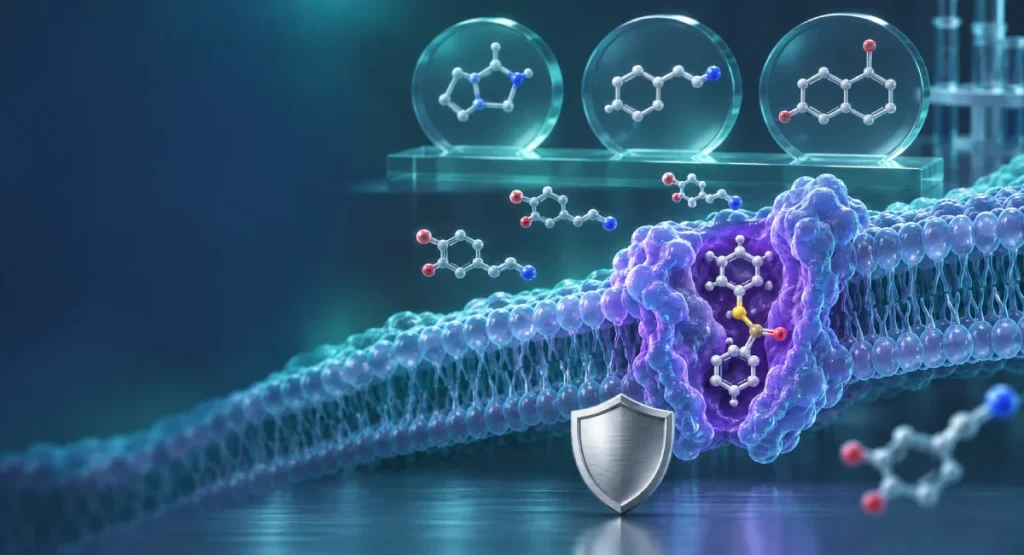
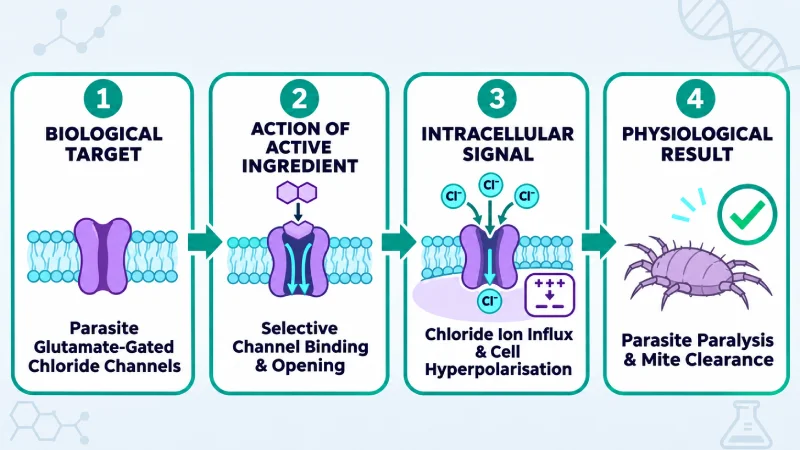
Ivermectin targets the nervous system of invertebrates. Tiny pores in the nerve and muscle cells of invertebrates like the Sarcoptes scabiei mite are targeted by this treatment, which attaches strongly to glutamate-gated chloride channels.
This binding increases cell membrane permeability to chloride ions. The rapid influx of negatively charged chloride ions causes hyperpolarisation (an electrical shutdown) of the nerve cells.
As a result, the parasite suffers paralysis and dies. Human nerve cells lack these specific peripheral channels, protecting you at standard therapeutic doses.
Because ivermectin does not kill unhatched mite eggs (it is not ovicidal), a second dose is typically required. Your prescriber schedules this repeat dose to eliminate newly hatched larvae before they mature.
How Long Ivermectin Stays in the Body
Understanding how your body processes ivermectin tablets in the UK helps explain why timing and food intake matter.
- Absorption: After oral intake, ivermectin reaches peak plasma concentration ($C_{\max}$) in approximately 4 hours ($T_{\max}$). In accordance with UK MHRA product licensing for ivermectin tablets, swallow tablets whole with water on an empty stomach (avoid food for 2 hours before and after dosing). Always follow your prescriber’s exact food instructions.
- Distribution: Ivermectin distributes widely into body tissues, including skin sebum and squames (outer skin layers), where mites reside. Because roughly 93% of the active substance attaches to plasma proteins in the bloodstream, it does not easily cross the human blood-brain barrier.
- Metabolism: Your liver breaks down ivermectin extensively using the CYP3A4 enzyme pathway (a primary liver enzyme system).
- Excretion: Over 98% of the dose leaves your body through faeces over 12 days. Less than 1% is excreted in urine. The elimination half-life (t½) is roughly 18 hours.
Approved UK Indications and Ivermectin Dosage for Scabies
In the UK, topical permethrin 5% cream remains the standard first-line treatment for scabies. Clinicians prescribe oral ivermectin dose for scabies (licensed in the UK as 3 mg tablets, such as Stromectol® or generic equivalents) as a second-line option.
Doctors recommend this scabies tablet treatment when topical creams fail, cannot be applied safely, or during institutional outbreaks. It is also essential for treating crusted scabies (a severe, hyperkeratotic form of infestation) alongside topical therapy.
Standard Weight-Based Dosing (Adults and Children ≥15 kg)
UK prescribers calculate oral ivermectin at 200 micrograms per kilogram of body weight as a single dose:
| Body Weight Range | Number of Tablets | Total Dose |
| 15 kg – 24 kg | 1 × 3 mg tablet | 3 mg |
| 25 kg – 35 kg | 2 × 3 mg tablets | 6 mg |
| 36 kg – 50 kg | 3 × 3 mg tablets | 9 mg |
| 51 kg – 65 kg | 4 × 3 mg tablets | 12 mg |
| 66 kg – 79 kg | 5 × 3 mg tablets | 15 mg |
| 80 kg and over | 6 × 3 mg tablets | 18 mg |
For classic scabies, doctors typically advise a second identical dose 7 to 14 days after the first dose. Patients with severe liver impairment require careful clinical review, as ivermectin is metabolised hepatically. Dose adjustments are not typically required when reduced kidney function is present.
Contraindications, Drug Interactions, and Scabies Prevention
Strict safety screening protects you from avoidable side effects and treatment failure.
Absolute Contraindications
| Safety Parameter | Clinical Guidance & Restriction |
| Hypersensitivity | Do not take ivermectin if you have a known allergy to the active salt or tablet excipients. |
| Low Body Weight | Because oral ivermectin is only approved for heavier patients, children weighing less than 15 kg cannot be given these tablets. |
| Pregnancy | Avoid ivermectin during pregnancy unless a specialist confirms the clinical benefit outweighs potential foetal risks. |
| Breastfeeding | Before you begin nursing your baby, your GP should be consulted because trace quantities of this medicine are excreted into breast milk. |
Drug-Drug Interactions
| Severity Level | Interacting Medication / Class | Clinical Effect | Management & Action Required |
| Major | Potent CYP3A4 inhibitors (e.g., ritonavir or ketoconazole) | Can raise ivermectin blood levels | Avoid concurrent use |
| Major | Warfarin (anticoagulant medicine) | May increase bleeding risks (elevated INR) | Use extreme caution |
| Moderate | CNS depressants (sedatives, benzodiazepines, or strong opioids) | May worsen dizziness or drowsiness | Exercise caution with concurrent use |
| Minor | Standard antihistamines (used for post-scabies itch) | Generally do not alter ivermectin clearance | No specific adjustments required |
Essential Scabies Prevention Measures
Successful eradication requires strict scabies prevention steps alongside oral tablets. All household members and close physical contacts from the past six weeks must receive simultaneous treatment, even without itching.
Machine-wash all bedding, towels, and recently worn clothes at 60°C or higher on the day of your first dose. Seal non-washable items in a plastic bag for at least 72 hours to starve remaining mites.
Accessing Treatment Safely in the UK
Under MHRA regulations, Stromectol (ivermectin) is classified as a Prescription-Only Medicine (POM). You must obtain medicine with a valid prescription from a registered healthcare professional. Your tablets are then supplied strictly by a GPhC-registered pharmacy to guarantee UK patient safety. Pharmacy (P) medicines, such as topical permethrin cream, may be supplied over the pharmacy counter after completing a clinical screening questionnaire, under the supervision of a pharmacist.
Never source unlicensed high-strength veterinary or overseas tablets from unverified websites. Always confirm your diagnosis with a GP or sexual health clinic before starting therapy.
 Official Guidance: Read the MHRA Ivermectin 3 mg Patient Information
Check Pharmacy: Verify a Dispenser
Possible Side Effects of Ivermectin
Most patients tolerate standard scabies doses well. Side effects are usually mild and temporary, often linked to the immune response as mites die.
| Frequency Category | Frequency Rate | Side Effects and Clinical Symptoms |
| Common | $\ge 1/100$ to $< 1/10$ | Transient worsening of itching (pruritus) during the first few days, mild dizziness, nausea, or fatigue. |
| Uncommon | $\ge 1/1,000$ to $< 1/100$ | Abdominal discomfort, diarrhoea, constipation, drowsiness (somnolence), vertigo (a spinning sensation), or tremor. |
| Rare / Serious | $< 1/1,000$ | Severe skin reactions such as Stevens-Johnson syndrome (blistering skin rash), toxic epidermal necrolysis, hepatitis (liver inflammation), or encephalopathy (brain dysfunction) in patients with co-existing Loa loa parasitic infections. |
Reporting Side Effects: Suspected side effects should be submitted directly to the MHRA by both patients and clinical staff using the Yellow Card app or online at yellowcard.mhra.gov.uk.
Frequently Asked Questions (FAQs)
Q: How quickly does ivermectin begin working for scabies?
A: Ivermectin begins paralysing and killing live scabies mites within hours of reaching peak blood levels. However, itching can persist for two to four weeks because of your body’s allergic reaction to dead mites. Your GP can recommend soothing emollients or antihistamines during recovery.
Q: What is the recommended dosing schedule for scabies?
A: When treating classic scabies, a single dose calculated at 200 micrograms per kilogram of body weight is issued by UK prescribers. You normally repeat this dose once after 7 to 14 days to kill newly hatched mites. Never take daily doses unless treating severe crusted scabies under specialist hospital supervision.
Q: Can you drink alcohol while taking ivermectin?
A: You should avoid alcohol while taking ivermectin or generic ivermectin tablets. Consuming alcohol during treatment can heighten the likelihood of experiencing low blood pressure, drowsiness, and dizziness, making it best avoided. Combining alcohol with antiparasitic therapy also places extra metabolic strain on your liver.
Q: How can patients access ivermectin legally in the UK?
A: You must access treatment responsibly with a valid prescription from a registered UK doctor or specialist clinic. Once issued, a GPhC-registered community or distance-selling pharmacy dispenses your 3 mg tablets. Supply without a prescription is not permitted for oral ivermectin in the UK.
Clinical References and Citations
- British National Formulary (BNF) Monograph: Ivermectin – Indications, Weight-Based Dosing, Contraindications, and Interactions (bnf.nice.org.uk).
- Clinical Particulars and Pharmacokinetics for Ivermectin 3 mg Tablets are detailed within the MHRA Summary of Product
- Clinical Knowledge Summaries (CKS) published by the National Institute for Health and Care Excellence (NICE) at cks.nice.org.uk.
Medical Disclaimer
This educational guide explains how this UK prescription-only medicine works, its uses, side effects, and generic packaging differences—always consult a healthcare professional before starting or changing treatment. We do not sell or dispense medicines; Prescription-Only Medicines (POMs) are supplied strictly by a valid NHS or private prescription.